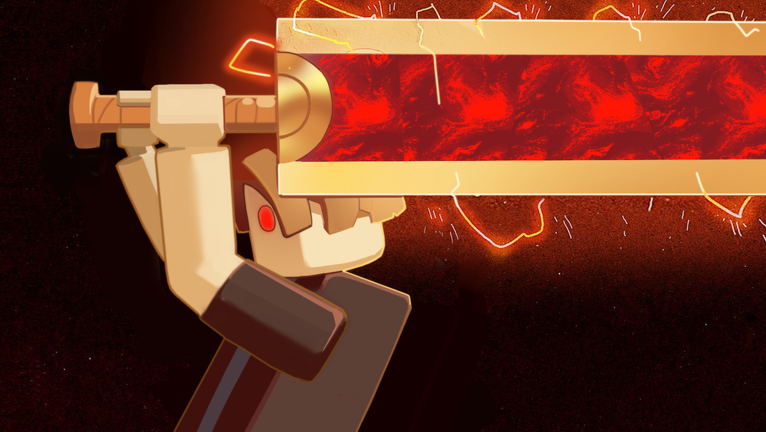
Combat in Broken Blade explicitly eschews the rudimentary button-spamming paradigms often found in peer titles. The engagement model is highly interactive, relying heavily on frame advantages, resource management, active parrying, and the distinct playstyles dictated by the specific weapon archetype equipped by the player.5 The player's agency in combat is defined by a dedicated mana or cooldown system tied to blue action buttons representing the primary combat skills, mapped to the Z, X, C, and V keys.5 Weapons are broadly categorized into three fundamental classes: Swords, Katanas, and Buster blades, each filling a distinct, mathematically defined niche within the combat meta.9
The Sword Archetype: Area of Effect and Resource Farming Dynamics
The standard Sword archetype operates as the premier tool for area-of-effect (AoE) damage and multi-target engagement.9 In an ecosystem where resource acquisition velocity is the primary determinant of progression speed, the ability to clear dense clusters of standard mobs and farm world chests simultaneously dictates the overall health of a player's economic standing. The Sword class naturally features wider sweeping hitboxes and horizontal slash arcs, allowing the wielder to strike multiple adversaries in a single skill rotation.9 Within this category, the Night Whisper sword is frequently cited within advanced player circles as a top-tier asset for engaging multiple enemies.9 For players focused on general farming routes—particularly when navigating densely populated islands or engaging in repetitive chest-farming circuits in mid-game zones—the Sword provides an unmatched utility that significantly reduces the time required to amass basic crafting materials like Obsidian, Bronze, and Steel. The strategic application of the Sword is not in boss elimination, but in crowd control. By utilizing the Sword, a seasoned player can aggregate enemy aggression (kiting), group the hostile entities into a centralized cluster, and dispatch them with a singular, high-damage AoE rotation. This maximizes the yield of experience points and currency per minute spent in the field.
The Katana Meta: Single-Target DPS and Infinite Action Looping
If the Sword is the instrument of the macroeconomic farmer, the Katana is the surgical tool of the endgame boss hunter. The Katana meta revolves entirely around maximizing single-target damage output through the exploitation of the game's resource cooldown system, making it the absolute optimal choice for high-tier boss encounters.9 Standard execution of the main attack skill (Z) drains the player's blue resource gauge, which naturally regenerates at a sluggish pace, leaving the player vulnerable during the downtime.9 However, the Katana class features unique, intentional interactions with the parrying system that allow skilled players to entirely bypass this cooldown limitation. The analysis indicates that the optimal Katana damage rotation is defined by an "endless loop" mechanic that requires precise input timing.9 The execution sequence is structured as follows:
- The player rapidly inputs the primary attack (Z) until the resource gauge is completely depleted.
- The player immediately inputs the primary parry command (C). Executing a parry—even outside of perfectly timing an enemy strike, though successfully blocking an active enemy attack with a standard block (F) or parry skills yields the same instantaneous benefit—triggers a complete and immediate replenishment of the action gauge.9
- With the gauge fully refilled, the player resumes the primary attack barrage (Z) until the gauge empties once more.
- The player then utilizes the secondary parry skill (X) to instantly refill the gauge a second time, capitalizing on independent cooldown timers for the C and X skills.
- This cycle repeats indefinitely, resulting in a continuous, uninterrupted stream of high-level burst damage that keeps the boss in a state of constant hit-stun.9
This mechanical loop demands a precise actions-per-minute (APM) cadence but rewards the user with the highest sustained single-target DPS possible. Furthermore, the ecosystem is populated with Trainer NPCs scattered across the various islands.5 These trainers offer specific, rigorous quests designed to upgrade the player's Z, X, C, and V movements alongside their fundamental parrying and blocking proficiencies. Completing these Trainer Quests is not optional for the seasoned player; it is a mandatory prerequisite that boosts raw ability damage and strengthens the overall structural integrity of the build, ensuring that the Katana's infinite loop scales aggressively as the player confronts the massive health pools of late-game adversaries.5
The Buster Archetype and The Explosion Paradigm
In stark contrast to the utilitarian efficiency of the Sword and the precise lethality of the Katana, the baseline Buster archetype is broadly evaluated as suboptimal within the standard progression meta.9 Buster blades are characterized by slow, ponderous animations that leave the player vulnerable to enemy counterattacks, interrupted combo chains, and crowd-control mechanics. For general early-to-mid gameplay, the Buster is considered highly inefficient and generally not recommended.9 However, advanced progression systems and recent updates reveal a critical exception to this rule. The introduction of the "Buster Explosion Weapon" mechanic in Update 5 fundamentally shifted the utility of the class.8 Furthermore, the endgame Dragon Slayer weapon relies on the Buster framework. While the base Buster archetype is flawed due to its frame data, these endgame iterations leverage specific, highly targeted multiplicative buffs (such as Buster-specific genetic Blessings) to transcend the class's natural limitations, transforming it into the highest single-hit damage dealer in the game. The exact mechanics of the Dragon Slayer build pipeline will be detailed exhaustively in a subsequent section of this report.9