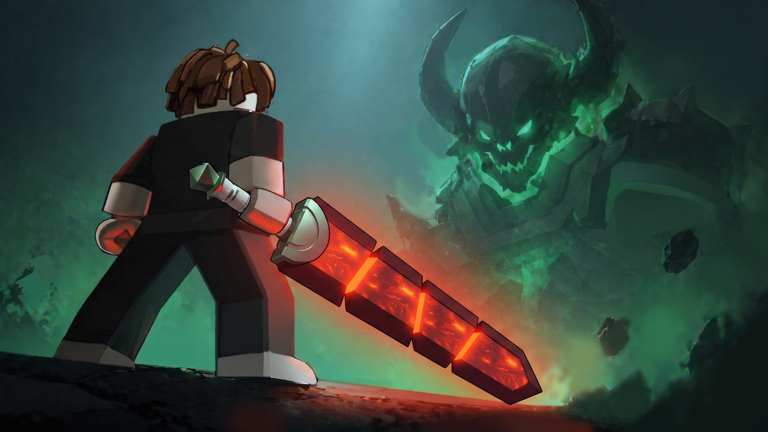
The world of Broken Blade is geographically fragmented into distinct, themed islands, each serving as an escalating threshold of mechanical difficulty and acting as a repository for unique resources, altars, and specific boss encounters.11 Understanding the geographic taxonomy is essential for optimizing farming routes, minimizing travel downtime, and managing the logistical overhead of traveling between disparate upgrade stations. Each island functions as a self-contained micro-economy that feeds into the macro-progression of the player.
Origin Island: The Starter Threshold and Baseline Economics
Players begin their journey on Origin Island, a rocky and grassy environment characterized by narrow pathways, treacherous cliff sides, and a shrouding light fog.11 This location serves as the foundational proving ground where players must acclimate to the physics engine and combat basics. The island contains standard quest-giving NPCs like the Block Master, a portal to subsequent locations, and notably, does not feature standard generalized weapon altars, but rather specifically hosts the Wind Fang and Stone Cleaver altars.11 The primary economic anchor of Origin Island is the Nameless Hero boss. Understanding the metrics of this boss is crucial for early-game resource modeling and establishing a baseline for TTK (Time To Kill) evaluations.
| Boss Entity | Health Points (HP) | Location | Drop Table Components |
|---|---|---|---|
| Nameless Hero | 30,000 | Origin Island | Sword Piece I & II, Emerald, Gold, Obsidian, Bronze, Steel, Bone, Stone, Fire Seed, Money, Gem, Nameless Star 11 |
The drop table of the Nameless Hero introduces players to the core economic loop. Harvesting materials like Emerald, Gold, Obsidian, and Steel is foundational for early weapon forging.12 Furthermore, the Nameless Star accessory provides a necessary baseline stat augmentation that early-game players must secure before advancing.12 Beyond the boss, Origin Island introduces the random spawning mechanic of "Gubby," an elusive entity. Defeating Gubby is a mandatory prerequisite for unlocking the specific "Gubby Nightmare" title, which itself provides passive stat augmentations critical for early-game min-maxing.11
Helheim: The Utility Hub and Reroll Economy
Following the mastery of Origin Island, players traverse to Helheim, described within the game's lore as the "land of resting souls, where the forgotten drift eternally".11 The visual aesthetic shifts dramatically to a teal-tinted, haunting atmosphere complete with ruined pillars, spectral torches, and the massive skeletal remains of an ancient creature situated at the rear of the island.11 Mechanically, Helheim operates as the primary utility and administrative hub of the mid-game. It houses the Master Z quest giver and, most importantly, the Reroll Shop.11 The Reroll Shop is arguably the most critical economic sink in the game. Here, players spend vast quantities of currency and dedicated reroll tokens to adjust their storage settings, manipulate their genetic Races, and alter their divine Blessings.9 Because the game's scaling is multiplicative, players will spend a disproportionate amount of their mid-game playtime stationed in Helheim, optimizing their Reroll settings to secure the Aesir or Vanir races. Additionally, Helheim contains a total of five standard altars distributed throughout its landscape, facilitating broader weapon forging than Origin Island, and like its predecessor, maintains a chance to spawn the Gubby entity.11
Muspelheim: The Infinite Forge and Diamond Economy
Progression eventually demands that players travel to Muspelheim. Themed heavily around fire, magma, and purgation, Muspelheim acts as the primary forge for mid-to-late game weapon enhancements.11 While earlier islands allow for the creation of weapons, Muspelheim is specifically engineered for the upgrading pipeline of endgame armaments. It is here that the Diamond Ore economy becomes the dominant factor in progression. Endgame weapons, particularly the Buster classes, require players to repeatedly utilize Diamond Ores—harvested painstakingly from other high-level locations—to push their armaments to the highest mathematical tiers.10 The scaling cost of these upgrades creates a massive economic friction point; seasoned players must model their farming routes to ensure a continuous influx of Diamond Ore, which is then transported to Muspelheim for expenditure.
Niflheim: The AFK Farming Singularity and Rune Economy
While the narrative progression leads naturally through the realms, Niflheim (frequently referred to colloquially by the player base as Nilheim) represents a functional singularity in the meta. Niflheim serves as the premier location for early-to-mid endgame AFK (away-from-keyboard) and highly optimized active boss farming.13 The spatial density and accelerated spawn rates of bosses in Niflheim make it the absolute optimal geographic location to farm Mythical and Legendary chests.13 The strategic value of these chests lies in their secondary drop tables: Raid Keys. By utilizing beginner guide setups optimized for AFK durability and AoE damage, players can continuously harvest Raid Keys.13 These keys are then immediately converted at specific NPC vendors into Raid Coins, which function as the exclusive currency required to purchase Runes, advanced Accessories, and Legendary items.13 Runes provide passive abilities and massive stat augmentations that are otherwise unobtainable.14 The Niflheim farming loop is therefore not just about experience; it is the sole engine driving the player's Rune and Raid Boss Armor economy.15 Without mastering the Niflheim circuit, a player's build will remain structurally deficient.
Jotunheim: The Endgame DPS Check Threshold
Jotunheim acts as the definitive, brutal endgame area for standard progression.16 Pushing into Jotunheim requires players to have already optimized their damage multipliers, secured their optimal Runes in Niflheim, and forged top-tier weapons in Muspelheim. Jotunheim functions as a pure DPS (Damage Per Second) check. The enemies here possess health pools and defensive mitigations that mathematically render un-optimized builds entirely non-viable. If a player attempts to enter Jotunheim without having stacked their multiplicative buffs, their TTK will extend beyond the survivability threshold, resulting in rapid depletion of their health reserves and ejection from the zone.
Eclipse Island: The Event Arena and Crimson Isolation
Eclipse Island is uniquely detached from the standard geographical progression path. It is a barren, circular wasteland surrounded by dark oceans, crimson skies, and dominated by a massive red energy barrier enclosing an empty battlefield.11 This location is entirely sterile regarding standard gameplay loops; it contains no standard quest-giving NPCs, no miscellaneous vendors, and strictly prevents Gubby from spawning.11 Instead, it serves a singular, monumental purpose: hosting the Eclipse Event. The island contains the exclusive Dragon Slayer weapon altar and acts as the sole arena for summoning the Guts (Eclipse) boss variants.11 To access the utility of Eclipse Island, players must bring external resources harvested from the broader world and utilize the island strictly as a proving ground and ultimate forge.